![youtube - [Video]](/web/image/product.image/2288/image_128/youtube%20-%20%5BVideo%5D?unique=00b6fe2)
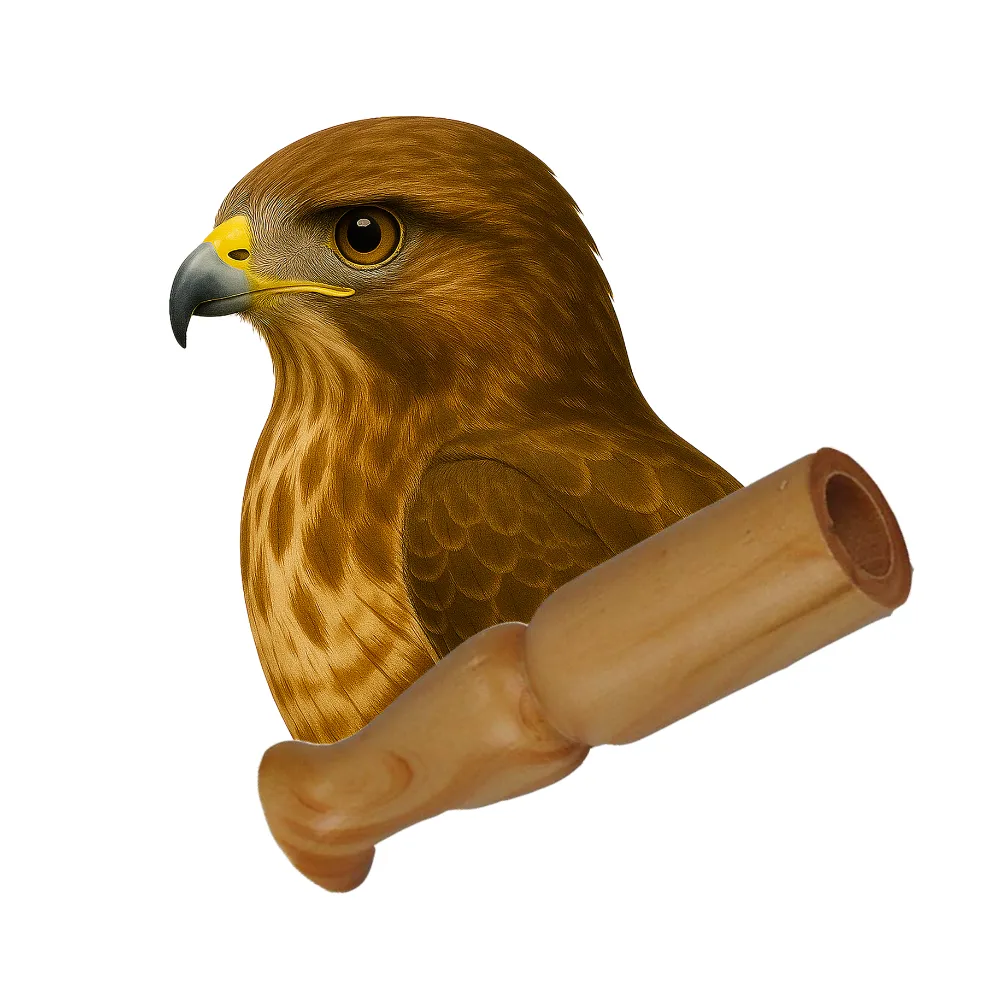
A call dedicated to the variable hawk
The variable hawk is a raptor well present in our countryside and recognizable by its characteristic vocalizations. Reproducing this type of cry requires a sufficiently precise call, but also a certain mastery of its use.
The call Les Zapos variable hawk is designed to reproduce the vocalizations of this raptor for use in the field.
For hunters
This call can find its place in the equipment of a hunter who wishes to have an additional means to work on the reactions of the birds present in the area, always in compliance with regulations and the species concerned.
How to use the Les Zapos – Common Buzzard call?
1
Observe before calling
Before blowing into the call, take the time to observe the area.
2
Produce a first vocalization
Do not immediately seek to achieve a high volume. Instead, work on consistency and tone to reproduce a credible vocalization.
3
Wait for the reaction
After a call, give the bird time to react. The absence of an immediate response does not necessarily mean that the call is useless.
4
Adapt calls to the situation
If a reaction occurs, gradually adjust your calls. Avoid multiplying sequences without reason.
Why buy the Les Zapos Common Buzzard call
Mimic a specific species
The call is specifically designed to reproduce the vocalizations of the common buzzard. You thus have a tool suitable for targeted use.
Easy to carry
Its compact format allows it to be easily integrated into a pocket or your field equipment.
Quick to deploy
A call should be usable when the situation arises. Here, there is no need for bulky equipment to start calling.
Useful for working on the approach
The call can complement your approach by providing an additional opportunity for interaction with the birds present in the area.
A complementary tool
It does not replace observation or knowledge of the territory. It complements your equipment when its use is relevant.
Adapted to the terrain
Simple and dedicated to a specific species, it corresponds to a philosophy of equipment that we appreciate in the field: compact and directly usable.

Valentin's opinion
I recommend this call if you are looking for a simple tool to have on you when working with the calls of the common buzzard. In the field, I especially like accessories that can be easily carried and used without taking out all your equipment.
I see it more as a complement to a good knowledge of the territory than as a solution that does everything on its own. As always with a call, practice and timing make the difference.
FAQ - Frequently Asked Questions
Its principle is simple, but achieving a credible imitation requires practice. Breath, rhythm, and intensity need to be worked on.
It can be used in different environments frequented by the common buzzard: countryside, agricultural areas, edges, or open sectors. The local context and the actual presence of the birds remain decisive.
Yes, but a learning phase should be planned. The most effective approach is to practice before using it in a real situation.
It is generally more relevant to start by observing the area. Knowing the presence, direction of movement, and behavior of the birds allows you to adapt your use of the call rather than calling for no reason.
Avoid systematically increasing the number or volume of calls. The lack of response may simply mean that no bird is nearby, that it is not receptive at that moment, or that the conditions are not favorable.
Work in spaced sequences and dedicate as much time to observation as to calling. If a reaction occurs, adapt to the behavior of the bird rather than mechanically continuing the vocalizations.